
City of Oaks Field Guide
A Field Guide to Raleigh's Trees
By Jordan Hale
Raleigh is the City of Oaks, but it's just as much a city of pines — the Triangle sits in the transition between Piedmont hardwood forest and the tall loblolly and longleaf stands of the coastal plain.
Knowing the species explains what you're seeing — and what to expect in a storm. A willow oak's spreading crown, a loblolly's shallow roots, and a dogwood's delicate structure each lead to different care.
This is a homeowner field guide, not a botanical key. When health or structure is in doubt, pair identification with an arborist assessment.
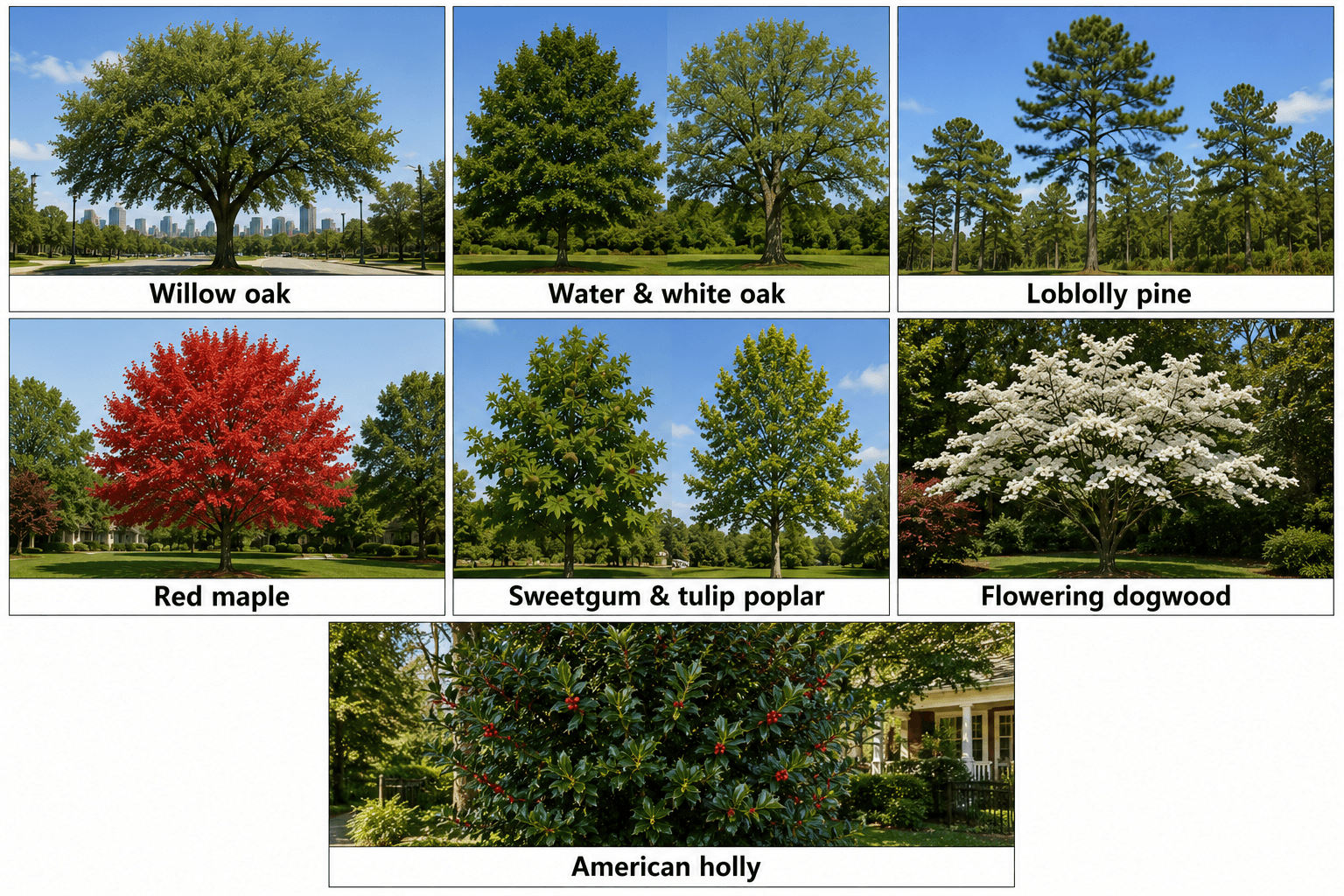
Trees That Define the Triangle Canopy
These species show up again and again from historic Raleigh to the booming suburbs and out toward Durham and Chapel Hill.
Willow oak
The tree Raleigh is named for — a fast, broad-crowned oak with narrow, unlobed leaves, planted along streets across the city. Older specimens need thoughtful end-weight reduction and roof clearance, never topping.
Water & white oak
Water oaks grow fast and decay early; white oaks are slow, strong, and long-lived with rounded lobes and pale bark. Both reward structural pruning and root protection during construction.
Loblolly pine
The defining Triangle tree — tall, fast, and everywhere. Shallow roots and slender tops make loblollies the region's most common failure in ice and wind. Watch for lean and snapped tops after storms.
Red maple
A fast-growing native in yards and wetter sites. Opposite branching and red buds are the tells. Early pruning corrects crowded unions before they become competing stems.
Sweetgum & tulip poplar
Sweetgum's spiky balls and star leaves and the tulip poplar's tall, straight trunk are common across the Triangle. Both drop brittle limbs in storms and benefit from canopy checks near structures.
Flowering dogwood
North Carolina's state flower and a beloved understory native with showy spring bracts. Dogwoods prefer protected root zones and light, selective pruning rather than heavy shaping.
American holly
An evergreen native with glossy, spined leaves and red berries, common in Triangle understories and yards. Slow-growing and tidy, it needs little more than occasional shaping.
Identification Changes the Care Plan
Species drives mature size, lifespan, decay patterns, storm behavior, pruning tolerance, and the season when work stresses the tree least.
It also sets what counts as normal. A water oak simply won't live as long as the white oak beside it, and a loblolly's shallow roots behave nothing like an oak's.
Before heavy pruning, check the tree against our Raleigh pruning calendar. If structure or health is uncertain, run through the hazard checklist.
Photograph the Clues That Matter
For ID, capture the whole tree, the branching pattern, bark, leaves or needles, any fruit or cones, and buds when you can.
Include the site. Soil, drainage, root space, sun, and nearby construction often explain condition better than a single leaf close-up.
Send those with your project details and we can point you toward pruning, monitoring, or the right service.
Raleigh Tree Identification Questions
Why is Raleigh called the City of Oaks?
For its willow oaks — the city planted them along streets for generations, and the spreading canopy became Raleigh's signature. Water oaks, white oaks, loblolly pines, maples, and dogwoods fill out the rest of the Triangle canopy.
Why do so many Triangle pines fall in storms?
Loblolly pines grow tall and fast with relatively shallow roots. Ice loading, saturated soil, and high wind make them the region's most common storm failure — worth inspecting before winter.
Are Bradford pears native to North Carolina?
No. Bradford pear is a cultivar of invasive Callery pear. Its weak unions split easily, and replacing it with a native like dogwood or a sturdy oak is often the better call.
Does species matter when deciding to remove a tree?
Yes, but never on its own. Expected lifespan, defect patterns, site fit, health, and the targets beneath the tree all weigh into the decision.
Keep reading
Related guides & services
Useful next steps from Raleigh TreeWorks across Raleigh.
Need Help Reading Your Trees?
Send photos of the tree and whatever's got your attention.
We can help narrow the species and recommend tree trimming, an arborist assessment, or removal when it's warranted.